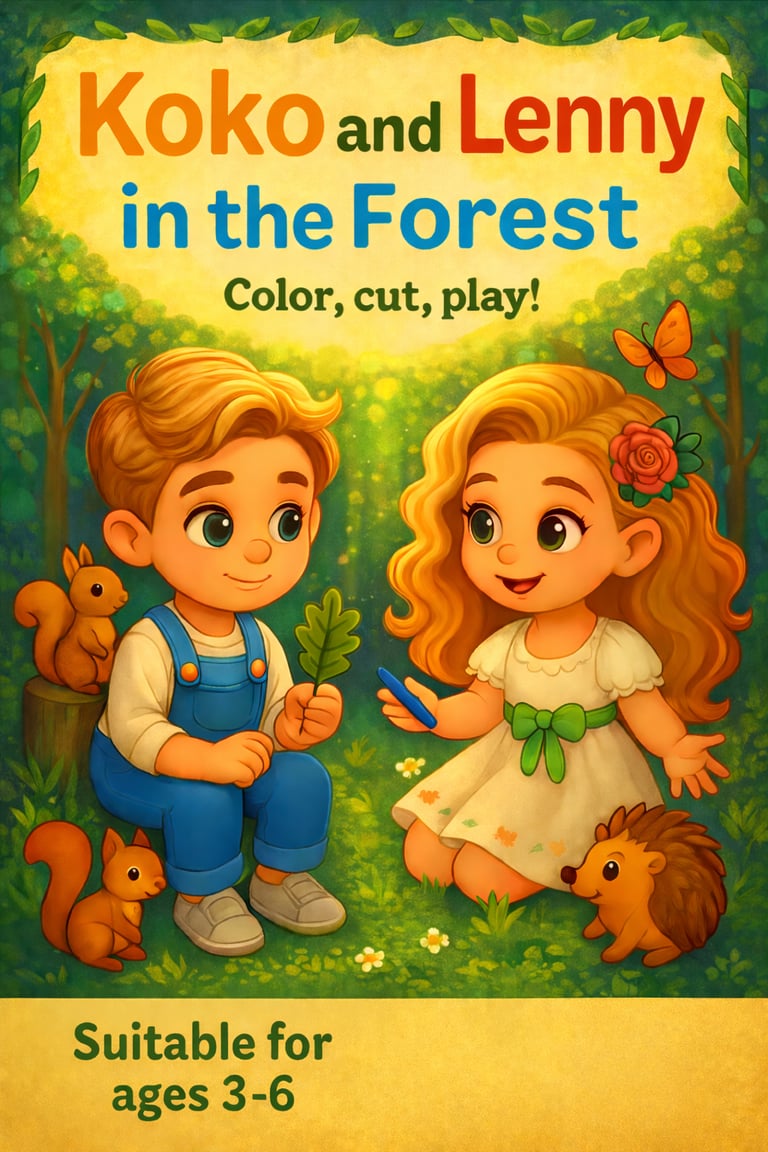
Koko and Lenny
in the Forest
Welcome to the bonus world of Koko and Lenny — where stories continue beyond the pages. Here you will find audio stories, songs, and additional resources designed to support imagination, calm moments, and shared play between children and adults.
🎵 Songs
📘 For Parents
🃏 Card Games
*Printable Color Card Set
NLP, rituals and children’s sleep — how it works in practice
Neuro-Linguistic Programming (NLP) in the context of children’s sleep is not used as suggestion or control, but as careful language design that helps the nervous system transition from activity to rest. For children, falling asleep is not an instant event — it is a shift from dominant beta waves (play, attention, arousal) to alpha and theta waves (imagination, imagery, dreaming). Stories and songs that use sensory imagery, repetition and gentle pacing support this shift, because the child’s brain naturally processes the world through images.
Linguistic markers of safety (“here it is calm,” “everything is well,” “tomorrow brings new adventures”) create a sense of security, which is a key requirement for sleep. The rhythm of language also matters: elongated phrases, soft verbs and repeated structures reduce the internal speed of the child. This is why bedtime stories do not rely on humor, action or plot peaks — such elements maintain beta dominance, while the goal at bedtime is theta. Music amplifies this effect through its influence on breathing. When the voice and melody are calm and continuous, the child begins to breathe more slowly, which is a direct physiological signal for sleep onset.
Audio formats do not replace parental presence — they support it. The parent’s voice is the first sound the child recognizes even before birth and has a naturally soothing role. For this reason, the story may be listened to or read aloud — both options are correct. The accompanying audio modules in this project create an evening ritual. The child is not “made” to sleep — the environment makes sleep possible.
Scientific and practical alignment
This approach is aligned with general recommendations for children’s sleep provided by organizations such as:
– American Academy of Sleep Medicine (AASM)
– National Sleep Foundation
How to use the cards — pedagogical value and practical guidance
The cards in this booklet are not only for play — they are designed as a developmental tool that engages the child on several levels at once. Every step of the process, from coloring to cutting and playing, supports skills that are fundamental for learning, emotional regulation and independence. When a child creates their own cards, they are not just preparing a game set — they are taking ownership of the learning material. This ownership, known in education as agency, significantly increases motivation, attention and willingness to participate. Children are far more likely to engage and persist in activities when they have contributed to the making of the tools themselves.
The coloring stage supports fine motor development, pencil control and early graphomotor coordination — skills that later translate into handwriting and academic readiness. Cutting with scissors activates bilateral coordination and strengthens planning, sequencing and hand-eye precision. From a neurological perspective, these micro-movements engage the parietal cortex and cerebellum, which are involved in both movement and cognitive integration. When the cards are finally ready to use, the child moves from preparation to active play. Depending on how the cards are played, different functions are stimulated: mime and gesture games encourage body awareness and nonverbal expression; guessing and exploration games stimulate vocabulary, curiosity and memory; movement games regulate energy and rhythm; question cards activate emotional literacy and storytelling.
For the parent, the cards are also a tool for connection. Children often struggle to verbalize experiences directly, but through play they share naturally and without pressure. That makes the cards helpful in moments of transition (after school, before bedtime) and in situations where the child needs a safe and structured way to express themselves. Why is this important? Because learning is not strongest when forced — it is strongest when embodied, meaningful and relational. A card made by the child is not just paper; it is a personal object that carries emotional value. This is why the child returns to it, uses it repeatedly and learns through it without perceiving it as a task. In short: the cards support skill building, independence and bonding, and they give the child a voice inside the learning process. And that is precisely what turns a simple booklet into a developmental experience.
PLAY, IMAGINE, SPEAK — THE PEDAGOGICAL VALUE OF THE CARD GAMES
The card games in this booklet are designed to do more than entertain. They activate different developmental systems at the same time — speech, imagination, emotional expression, motor coordination and social interaction. These elements are often separated in traditional educational materials, but in early childhood they belong together. Children learn best when the whole system is engaged, and play is the most natural way for it to happen.
1. “Imitate Me!” — learning through embodiment The first card game invites children to imitate animals and characters using gestures, sounds and small theatrical expressions. This form of play is known as embodied learning — the body becomes part of the thinking process. When a child growls like a bear, hops like a rabbit or spreads their arms like an owl, they are not just mimicking; they are practicing:
• motor planning (deciding how to move)
• body awareness (where and how the body is in space)
• nonverbal expression (communicating without words)
• role-taking (imagining being someone or something else)
These are key components of creative thinking and emotional development. The game also encourages turn-taking, waiting, observing and responding — all foundational social skills. Because the activity is playful and not evaluative, children participate freely and often surprise adults with how expressive they are when there is no pressure to “perform.”
2. “Fairy Tale with Cards” — imagination meets language The second card game moves from the body to language. Children draw cards and build short stories involving the characters they received. To construct even a tiny story, the brain must activate narrative functions: who, where, when, what happened, and how it ended. This supports the formation of story schemas — internal patterns that later make reading, writing and comprehension easier. Storytelling also trains:
• expressive vocabulary (finding words for ideas)
• sequencing (ordering events)
• perspective-taking (imagining what characters think or feel)
• flexible thinking (combining unlikely elements)
• humor and creativity (inventing new situations)
For younger children who are not yet fluent speakers, the game can be simplified to naming, describing or narrating one character. For older children, it can be extended into longer stories, group tales or miniature theater.
3. Why these games help children learn?
Play with characters and stories is not random. It mirrors the way the developing brain organizes information about the world. Children naturally classify animals by characteristics, imagine hidden intentions and assign roles. Through play, these categories become more refined and connected. And when play is shared with an adult, the experience becomes relational — the child learns not only from the material but also from the dialog. The card games also provide a bridge between movement, speech and emotion. A child who curls into a ball like a hedgehog is also embodying shyness. A child who tells a fantastic story as a fox is exercising imagination and confidence. These layers are not accidental — they make play meaningful.
4. A tool for parents
For parents, these games are a gentle doorway into conversation. Children often share experiences more easily when talking “as the character” than “as themselves.” A hesitant child may not say, “I was scared today,” but may happily narrate how “the rabbit was afraid and ran.” This indirection is not avoidance — it is safe expression. Parents can support it by asking open questions, listening and allowing the story to unfold without correction.
5. When learning feels like play, children stay
Most importantly: learning that feels like play is learning that remains. When children enjoy a game, they return to it voluntarily. Repetition builds skills. And when the child created the cards themselves, the material becomes personal — something to be cherished, used and carried into their inner world. In this sense, the booklet is not a collection of activities, but an invitation into imagination, movement and connection — the three places where childhood grows strongest.